Fruit and vegetable fuse bead patterns: watermelon, kiwi, apple, pumpkin and play food
Fruit is the easiest thing to make in fuse beads: the colours are obvious, the shapes are round and a slice is just a half circle. Here is how to make a watermelon slice, a kiwi, an apple, a strawberry, a pumpkin, a tomato and a carrot, what goes wrong with seeds, and how the pieces turn into play food for the toy kitchen, a garland or a set of fridge magnets.
Updated 28 October 2026
Why is fruit the best first fuse bead subject?
Fruit is the best first subject because nobody has to decide on colours: ask a child what colour a banana is and you get the answer at once. The shapes help too: they are circles, ovals and half circles that still look right when a bead is off. A fruit piece needs two to four colours, fits on one pegboard and is finished in one sitting.
Fruit has a second advantage in beads: it comes as a whole and as a slice, and the slice is often the better picture. A whole kiwi is a brown oval. A kiwi slice is a bright green circle with a white centre and a ring of black seeds, and everyone recognises it.
Whole and slice: make them as a pair
A good habit is to make each fruit twice: once whole, once cut open. The whole fruit shows the outside colour, the slice shows the inside. Together they make a small set that children like to lay out, and the two pieces use the same beads, so you only sort once.
- Watermelon: a dark green oval with lighter stripes, and a red slice with a green rind.
- Orange: an orange circle with a small green leaf, and a slice with pale spokes.
- Kiwi: a brown oval, and a green slice with a white centre.
- Tomato: a red circle with a green star on top, and a slice with pale pink chambers.
The fruit, one by one
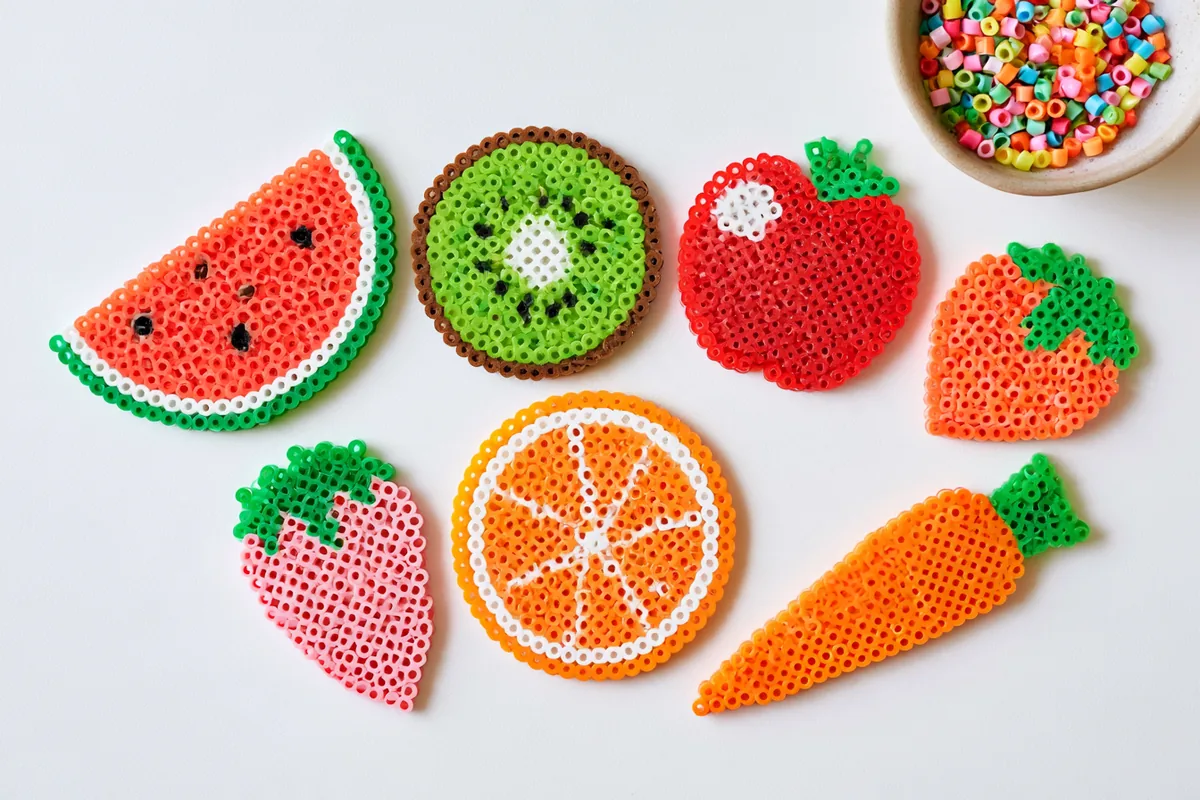
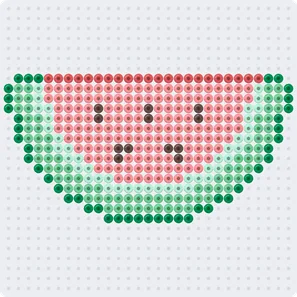
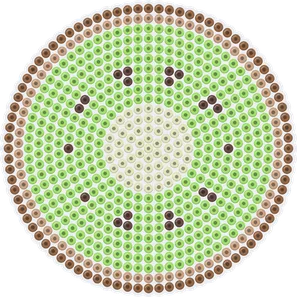
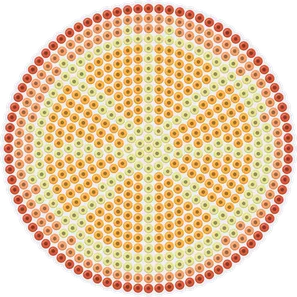
The four slices below are from the Fruit pack; tap one to see it on its board.
Watermelon slice
The watermelon slice is the classic. Lay a half circle in red, then a thin white line along the curved edge and a green rind of two beads outside it. Put a few black seeds in the red, never on the edge. Perler's own watermelon project uses exactly this idea with four colours: magenta, a lime green, black and white.
Kiwi slice
A green circle, a white oval in the middle, and black seeds in a ring around the white. Use a brighter green for the inside and, if you have it, a darker green for the outer edge. The seeds are the part children enjoy, so let them place those.
Apple
A red or green rounded shape, slightly wider than high, with a dip at the top. The stem is brown and two beads wide, not one, so it does not snap off. A single green leaf next to the stem is enough. A bite out of one side makes it funnier and uses the white beads.
Strawberry
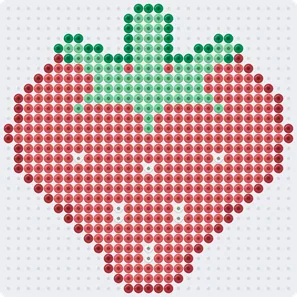
A rounded triangle in red with a green top of three or four points. The seeds are the trap: on a small strawberry, black seeds look like holes. Use yellow seeds, spaced out, and leave the edge free of them.
Orange slice
An orange circle with a thin lighter rim and pale spokes from the centre, like a wheel. Six spokes on a round board look right; eight get crowded. The whole orange is the same circle without spokes, plus a leaf.
Banana
A curved yellow shape, three beads wide in the middle and tapering to two at the ends, with a brown tip. Keep the curve gentle: a banana that bends too far breaks into single beads on the inside of the curve.
Vegetables
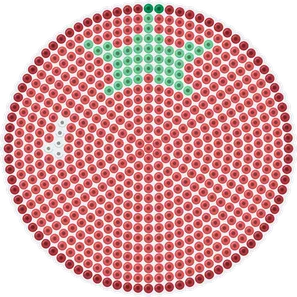
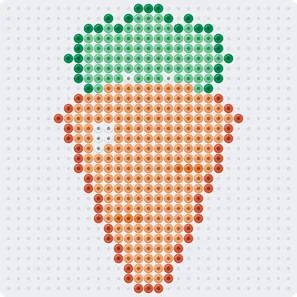
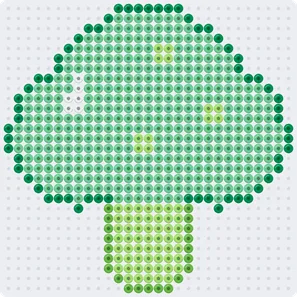
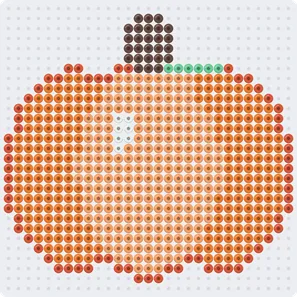
From the Vegetables and Autumn packs: three shapes that work in two colours, and the pumpkin with its darker segment lines.
Pumpkin
A wide orange shape with a flat bottom and a green stem on top. The segments are the secret: a few vertical lines in a darker orange turn a blob into a pumpkin. If you only have one orange, leave the segments out and make the stem bigger. This pumpkin is the base for the Halloween version with a face, so it is worth learning before October.
Tomato and carrot
A tomato is a red circle with a green star of five short points at the top. A carrot is a long orange triangle, three beads wide at the top, with a bushy green top. Give the carrot a couple of darker lines across it and it stops looking like a traffic cone.
Broccoli and cucumber
Broccoli is two greens: a dark green bumpy top on a pale green stalk. Make the bumps by leaving out single beads along the top edge. A cucumber is a long dark green oval; its slice is a pale green circle with a darker rim and a few lighter dots.
Why do seeds and stems fall off?
Seeds, stems and leaf tips fall off when they are single beads, and they are where fruit pieces fail. A bead that touches only one neighbour has almost nothing to fuse to and falls off after ironing or the first time the piece is dropped. The rules that help:
- Seeds inside the shape, never on the edge. A seed surrounded by red is held on all sides.
- Stems and leaf tips at least two beads wide.
- Two tones of one colour are enough. A dark and a light green make a kiwi; a third green adds sorting without adding a picture.
- Iron both sides. Fruit pieces get handled a lot, so turn them over and iron the back too.
Play food for the toy kitchen and the shop game
Fused fruit is flat, light and washable, which makes it better play food than most of what comes with a toy kitchen. Make a basket of it and the beads get played with for years.
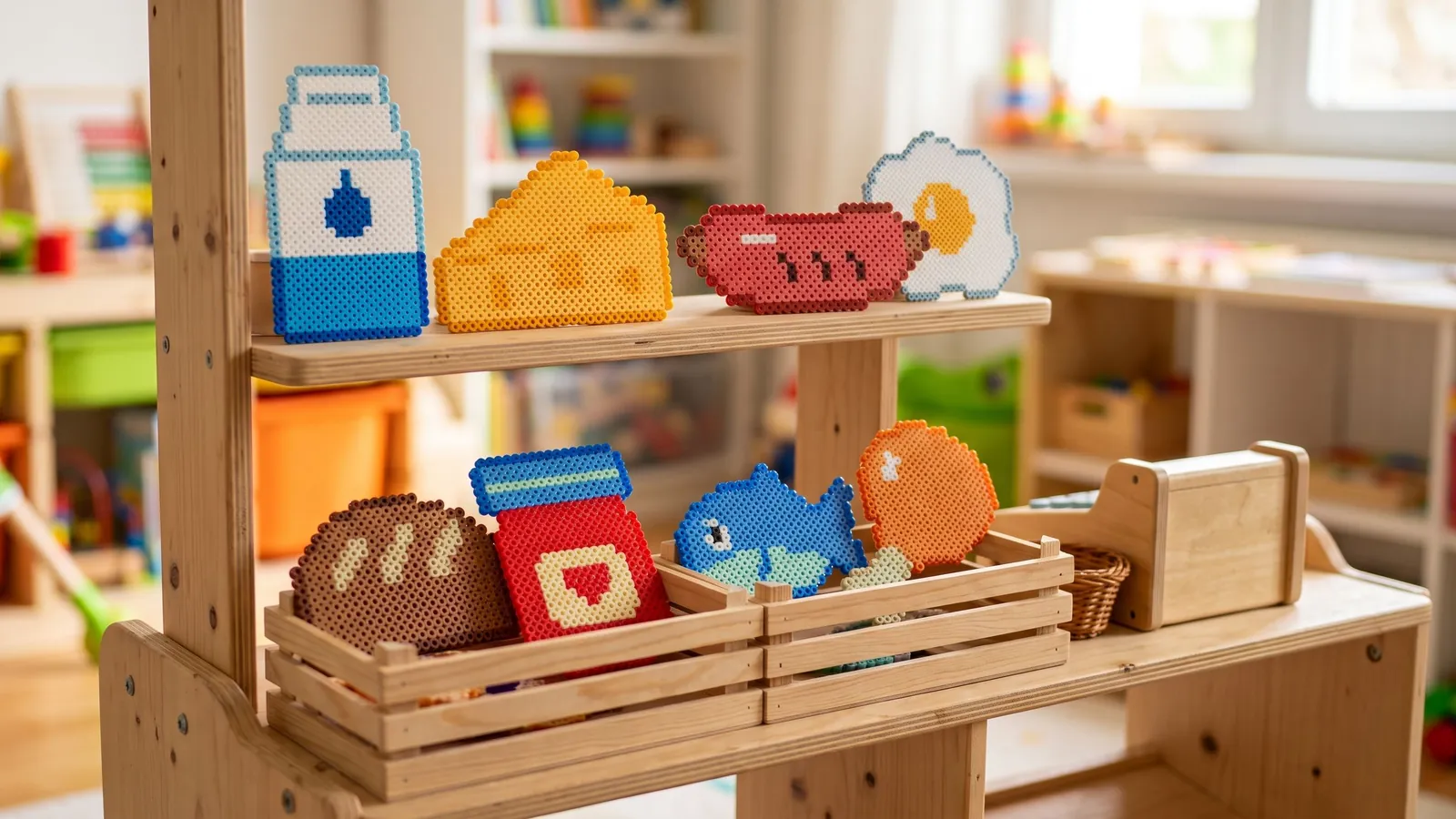
- The shop. Fruit and vegetables on one side of the table, a child behind it, a price on a scrap of paper next to each piece. Small fused squares in one colour are the money.
- Sorting. Before anyone starts beading, a three-year-old can sort the loose beads by colour into the sections of a tray. For that age, that is the whole activity.
- Breakfast. A fried egg, a slice of bread, a piece of cheese, a sausage and a carton of milk cover a toy breakfast. Each is one pegboard and two or three colours.
- Counting. Five strawberries, three bananas: fruit pieces make a counting game that does not look like homework.
A fruit garland, magnets and coasters
- Garland. Iron the pieces lightly so the holes stay open, then thread a cord through two holes in each piece so it hangs straight. Eight to ten pieces of mixed fruit make a garland for a kitchen window.
- Fridge magnets. Glue a small magnet to the back once the piece has cooled. A watermelon slice and a kiwi slice are the ones people ask for.
- Coasters. A whole orange or a watermelon slice on the large round board, ironed hard on both sides so it lies flat.
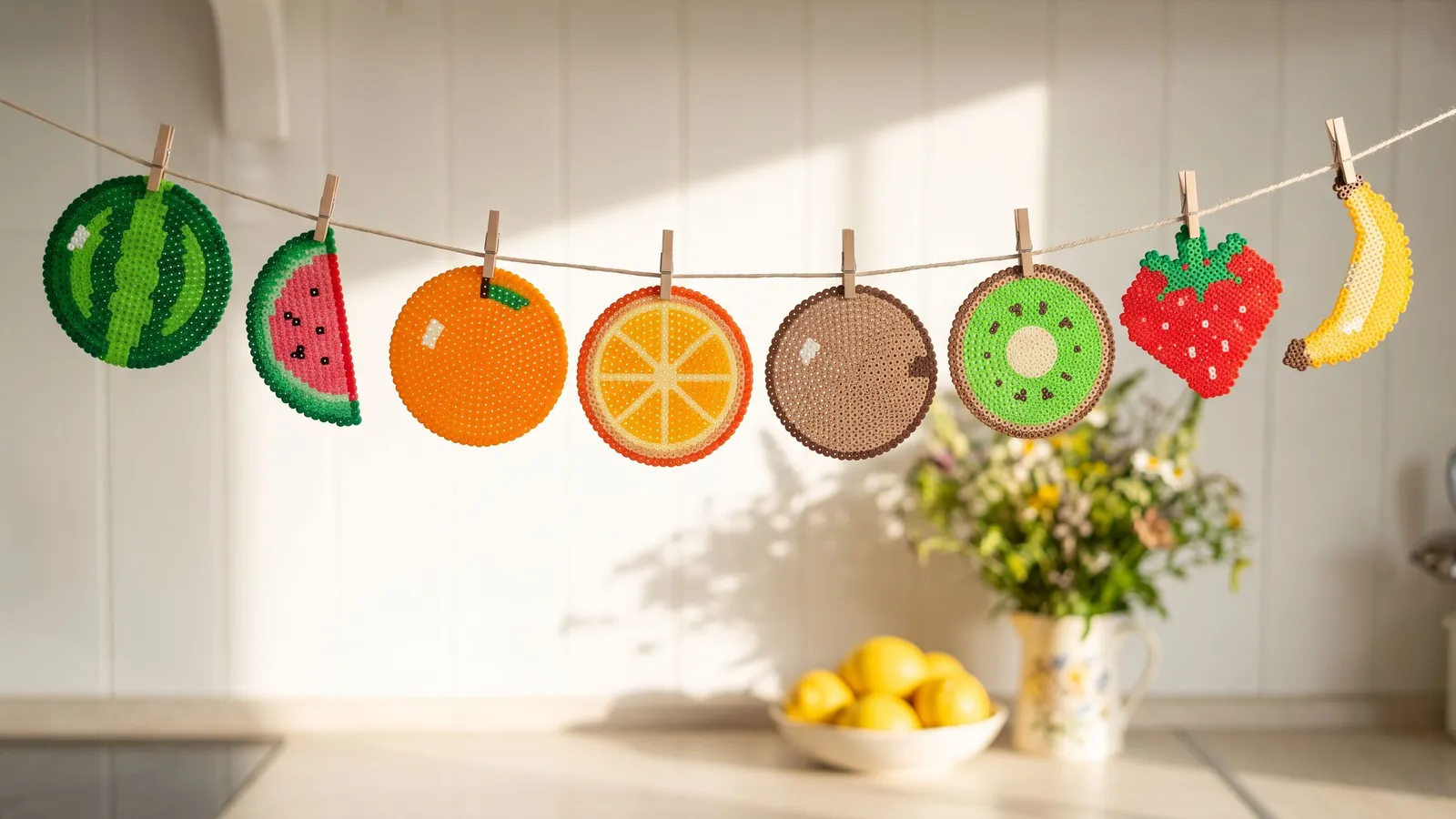
Which pegboard is best for a fruit slice?
A slice reads better on a round pegboard, because the outer ring of pegs already gives you the rind. Hama's large round midi board (no. 221) has 631 pegs and is sold for ages 5 and up; the large square (no. 234) has 841. Perler includes a circle board in its basic shapes set. On a round board the rind is the outside ring, the flesh is everything inside it, and the seeds go wherever the child wants.
The round board also solves a problem the square board has: a circle on a square board has a stepped edge, and children find the steps hard to count. On the round board the edge is given.
Ready-made patterns, and your own
If you want the patterns drawn out with every bead and colour, Kippadoo has them in packs of eight, one pegboard per pattern, printed at actual size with the colour counts. The slices and other round pieces are on the round pegboard.
- Fruit pack: watermelon and watermelon slice, orange and orange slice, kiwi and kiwi slice, strawberry, banana.
- Vegetables pack: tomato and tomato slice, cucumber and cucumber slice, red onion and onion half, carrot, broccoli.
- Play food pack: milk, cheese, sausage, fried egg, bread, jam, fish, drumstick.
- Sweet treats pack: doughnut, cookie, lollipop, cupcake, ice cream, ice lolly, macaron, cake.
- Autumn pack: pumpkin, apple, acorn, toadstool and more.
Each Kippadoo pack has one free pattern to try first. And for a fruit that is not in any pack, photograph the real thing on a plain table and let the pattern maker turn the photo into a pattern. A single piece of fruit with good light and nothing behind it works well; a whole fruit bowl does not.
Where to buy
The links below go to a search on Amazon. They are paid links: Kippadoo earns from qualifying purchases, and the price stays the same for you.
- Hama midi beads in single colours (red, green, yellow, orange) (paid link)
- Hama large round pegboard no. 221 (paid link)
- Hama ironing paper (paid link)
- Small self-adhesive magnets (paid link)
Sources
- Hama, Midi pegboard large round: no. 221, 631 pegs, from 5 years.
- Hama, Midi pegboard large square: no. 234, 841 pegs.
- Perler, Biggie Beads Watermelon: magenta, kiwi lime, black and white; medium setting; beads keep open centres.
- Perler, Small Basic Shapes Clear Pegboards: a set that includes a circle board.
- Hama, Instructions: an adult irons, ironing paper, circular strokes, cotton setting for Midi, keep the iron off the pegboard.
As an Amazon Associate, Kippadoo earns from qualifying purchases.
Questions
A watermelon slice: a red half circle, a white line, a green rind and a few black seeds. Four colours and one pegboard.
A seed on the edge touches only one or two beads and has little to fuse to. Keep seeds inside the shape and iron both sides.
A round one. Hama's large round midi board (no. 221, 631 pegs) gives you the rind as the outer ring. Perler includes a circle board in its basic shapes set.
Yes. The pieces are flat, light and washable. Iron both sides so they survive the toy kitchen.
Yes. Photograph one piece of fruit on a plain surface in good light and use a pattern maker such as Kippadoo's. Expect a simplified picture.