Easy fuse bead ideas for beginners and children
The easiest fuse bead designs have few colours, a clear outline and fit on one pegboard. Below are ideas in groups, from a first heart on a shaped board to keyrings, coasters and a portrait of your pet, with a line on how to make each one and tips for doing it with children.
Updated 28 October 2026
What makes a fuse bead design easy?
A fuse bead design is easy when it is quick to place and hard to get wrong; knowing why helps before you pick an idea. An easy design has:
- Few colours. Two to four colours means less sorting and fewer mistakes. A strawberry needs red, green and maybe a few black seeds.
- A clear outline. A shape you can recognise from its edge alone, such as a heart, a fish or a leaf, still looks right if a bead or two is off.
- One pegboard. A design that fits on a single board can be made and ironed in one go. Joining boards comes later.
- No single loose beads. A bead that only touches one neighbour, such as the tip of a whisker, breaks off easily after ironing. Make thin parts at least two beads wide.
- A shape that matches the board. On a heart-shaped board the outline is already there; you only fill it in.
Which pegboard is best for a first project?
A shaped pegboard: Hama and Perler both sell them. Perler has a set of small boards with a heart, a star, a circle, a hexagon and a square, and Hama sells midi boards in shapes such as a heart and a star. For a first project these take away the hardest part: deciding where the edge goes.
- A striped heart: fill the heart board row by row, changing colour every two or three rows.
- A star in one colour with a different centre: fill the middle first, then work outwards.
- A circle as a face, a planet or a ladybird: a round board gives you the outline; add two eyes, a ring or a few black spots.
- A rainbow on any shape: lay the colours in rings or stripes. It uses up odd colours and needs no pattern.
Animals
Animals are the most popular choice for children. Pick ones with a strong outline and few colours.
- Fish: an oval body and a triangle tail, in one or two colours, with one bead for the eye.
- Ladybird: a red circle with black spots and a black head, ideal for the round board.
- Frog face: a green rounded shape with two white eyes on top.
- Butterfly: two wings that mirror each other, so a child only has to think about one side and copy it.
- Paw print: four small pads and one big one, in a single colour. Keep the pads at least two beads wide.
If you want ready-made versions, the animals pack has eight one-pegboard animal patterns.
Food and fruit
Fruit is easy because the colours are obvious and the shapes are simple.
- Watermelon slice: a half circle in red, a green rind along the bottom edge, a few black seeds.
- Strawberry: a rounded triangle in red with a green top and yellow or black seeds.
- Orange slice: a circle in orange with lighter lines from the centre, like spokes.
- Fried egg: a white blob with a yellow circle in the middle; the blob does not have to be even.
- Doughnut: a circle with a hole in the middle and a different colour on top for the icing.
The fruit pack has eight fruit patterns like these, on one board each.
Nature
- Leaf: an oval with a point and a darker line down the middle. Make a few in autumn colours.
- Flower: a yellow centre with five or six round petals around it.
- Toadstool: a red half circle with white dots on a white stem.
- Sun or cloud: a yellow circle with short rays, or a white cloud with a grey edge.
Leaves and flowers are in the nature pack.
Useful things
Children are often prouder of something they can use. These need a little more than a pegboard.
- Coasters: fill a square or round board in a simple pattern and iron both sides well, so the piece is stiff and flat.
- Fridge magnets: make a small design and glue a magnet to the back once it has cooled.
- Keyrings and bag tags: iron lightly so the holes stay open, then open a jump ring with pliers, put it through a bead hole near the top edge and attach a split key ring. Perler's own keychain projects work this way.
- Bookmarks: a long strip two or three beads wide, with a small shape at one end.
- Name tags: letters in a simple block font, each at least two beads thick. A longer name fits better across two boards side by side.
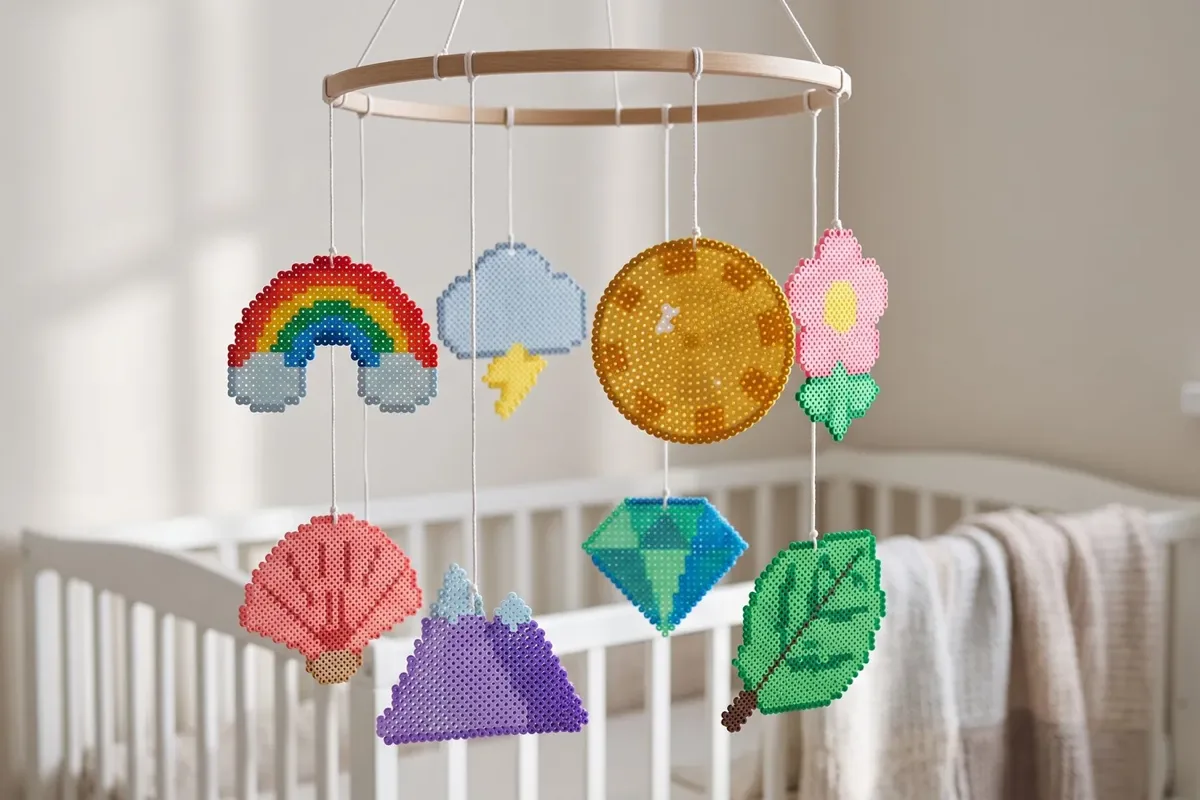
- Garlands: make several small shapes, such as hearts or stars, and thread a string through a bead hole in each.
Gifts
A small fused piece is a good present from a child: a heart for a grandparent, a magnet for a teacher, a keyring for a sibling.
A portrait of a pet or a person takes more colours and more time, but children like seeing their own dog or cat in beads. Kippadoo's pattern maker turns a photo into a pattern; it works best with a close-up, a plain background and good light, and the result is a simplified version of the photo, not a copy. Choose one pegboard for a first portrait.
Characters from games and films are popular, but for sharing or selling stick to your own designs.
Games
- Counting: make number pieces from 1 to 10, each with the matching number of dots in a contrasting colour.
- Colour sorting: before starting, let small children sort a handful of beads by colour into the sections of a tray. That is a game in itself.
- Noughts and crosses pieces: five crosses in one colour, five rings in another, and a grid drawn on paper or made from beads.
- Memory: make pairs of simple shapes and iron them; turn them face down and play.
Doing it with children, by age
- From about 3: Hama Maxi beads (10 mm) are sold for ages 3 and up, and Perler sells its Biggie Beads for ages 4 and up. Bigger beads are easier for small hands to pick up and push on.
- From about 5: Hama sells its Midi beads and boards for ages 5 and up; this is the usual size. Start with a shaped board and a two-colour design.
- Older children: can follow a pattern on their own, work across more than one board and try mini beads if they have the patience.
Which size suits which age is explained in fuse bead sizes: mini, midi and maxi.
Keep sessions short with young children. One small piece that gets finished and ironed the same day is worth more than a big one that stays half done on the board.
Where to buy
The links below go to a search on Amazon. They are paid links: Kippadoo earns from qualifying purchases, and the price stays the same for you.
- Shaped pegboards (heart, star, circle) (paid link)
- A starter box with mixed colours and pegboards (paid link)
- Key rings and small magnets for finished pieces (paid link)
Sources
- Perler, Small Basic Shapes Clear Pegboards: heart, star, circle, hexagon and square boards, ages 6 and up.
- Hama, Midi pegboard large heart: a heart-shaped midi board, from 5 years.
- Hama, 400 Maxi beads and tinned pinboards: Maxi beads for children aged 3 and over; the ironing must be done by an adult.
- Perler, Biggie Beads Bucket: Perler's large beads, ages 4 and up.
- Perler, Pineapple Keychain: a keychain project with a key ring and jump ring.
As an Amazon Associate, Kippadoo earns from qualifying purchases.
Questions
A design on a shaped pegboard, such as a heart or a star, in two or three colours. The board gives the outline, so you only fill it in.
Few colours, a clear outline, a size that fits one pegboard and no single beads sticking out on their own.
Hama sells Maxi beads for ages 3 and up and Midi beads for ages 5 and up. Perler sells Biggie Beads for ages 4 and up. An adult does the ironing.
Iron lightly so the holes stay open. Put a jump ring through a bead hole near the edge, close it with pliers and hang it on a split key ring.
Yes. A pattern maker like Kippadoo's turns a photo into a bead pattern. Use a close-up with a plain background, and expect a simplified picture.