Christmas fuse bead ideas: ornaments, an advent calendar of patterns and gifts children can make
December is when most fuse bead pieces are made, and most of them are given away. Below are ornaments that hang straight, a plan for making one small pattern a day through Advent, gifts a child can finish in an afternoon, a star for the top of the tree, and how to pack it all so it comes out whole next year.
Updated 28 October 2026
Why Christmas is the fuse bead season
Three things come together in December: children are indoors, the house needs decorating, and every grandparent, teacher and neighbour gets a present. A fused piece answers all three. It costs a few cents in beads, it takes an afternoon, and a slightly uneven star made by a six-year-old is a better present than anything from a shop.
The catch with Christmas pieces is time. If you want a garland, a set of ornaments and a few gifts, start in November. One pegboard a day is a comfortable pace with children; an hour on a Saturday gets you three or four pieces, ironed and cooled.
How do you make a bead ornament hang straight?
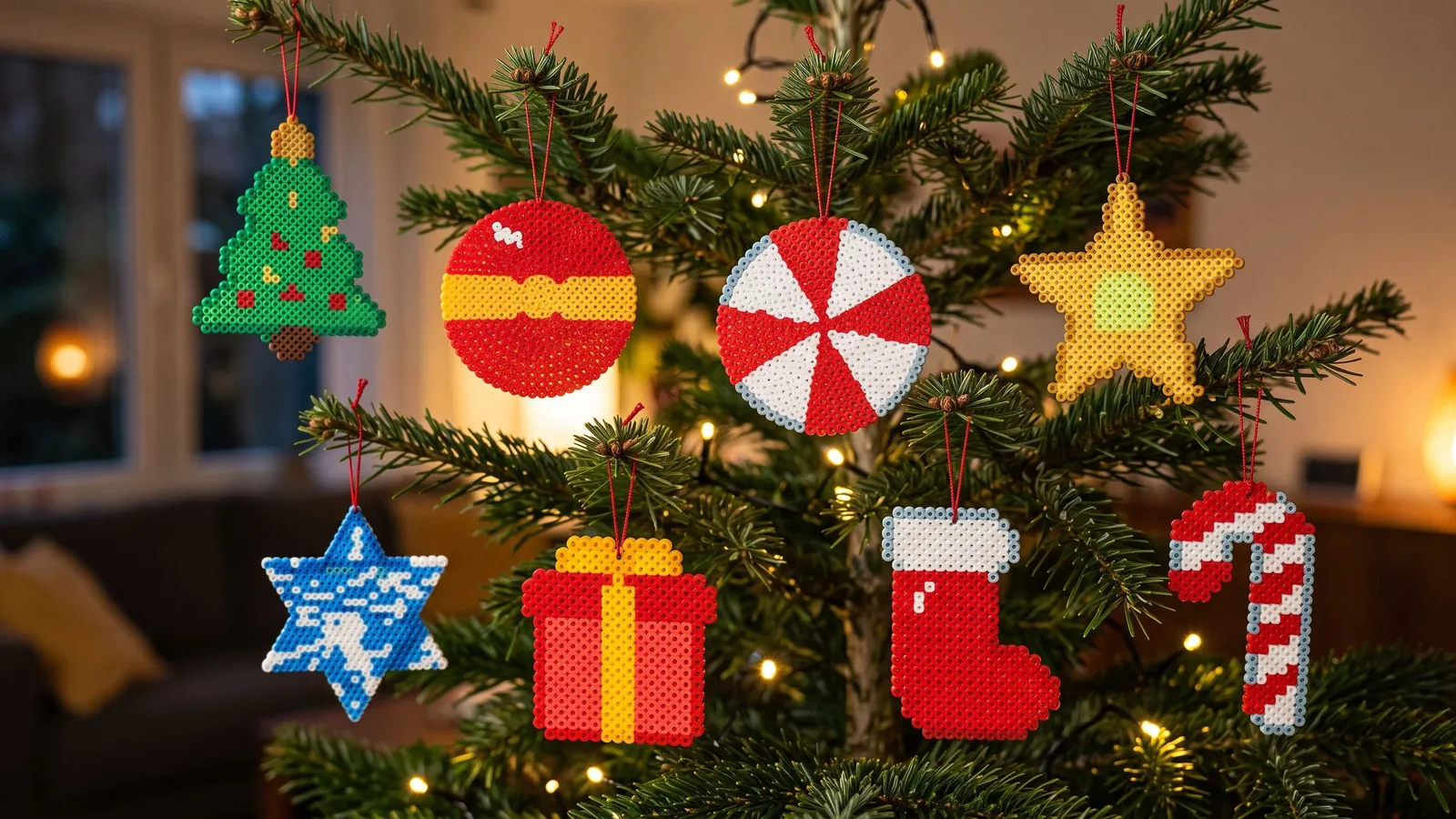
A bead ornament hangs straight when the ribbon hole is in the right place and both sides are ironed. An ornament has two jobs a coaster does not: it must hang level, and it must survive a month on the tree and a year in a box. Both come down to where the hole is and how you iron.
The hole for the ribbon
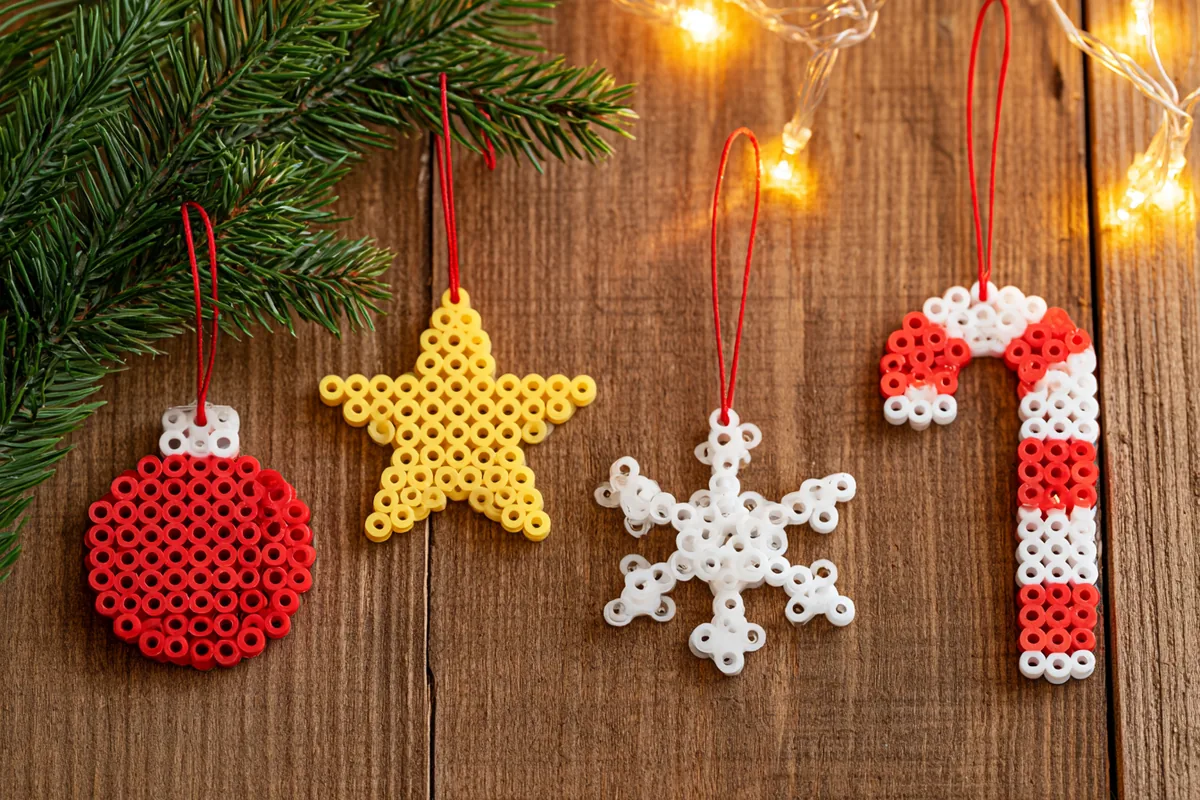
Plan the hole before you place the first bead. Perler's own ornament projects run the ribbon through one or two beads at the top edge, from the back to the front, and tie a bow. Two holes side by side hang more level than one; a single hole lets the piece spin. Keep at least two rows of beads above and around the holes, so the ribbon doesn't tear through. Iron lightly at the top so those holes stay open; if they close, a jump ring through a bead and the ribbon through the ring also works.
Iron both sides
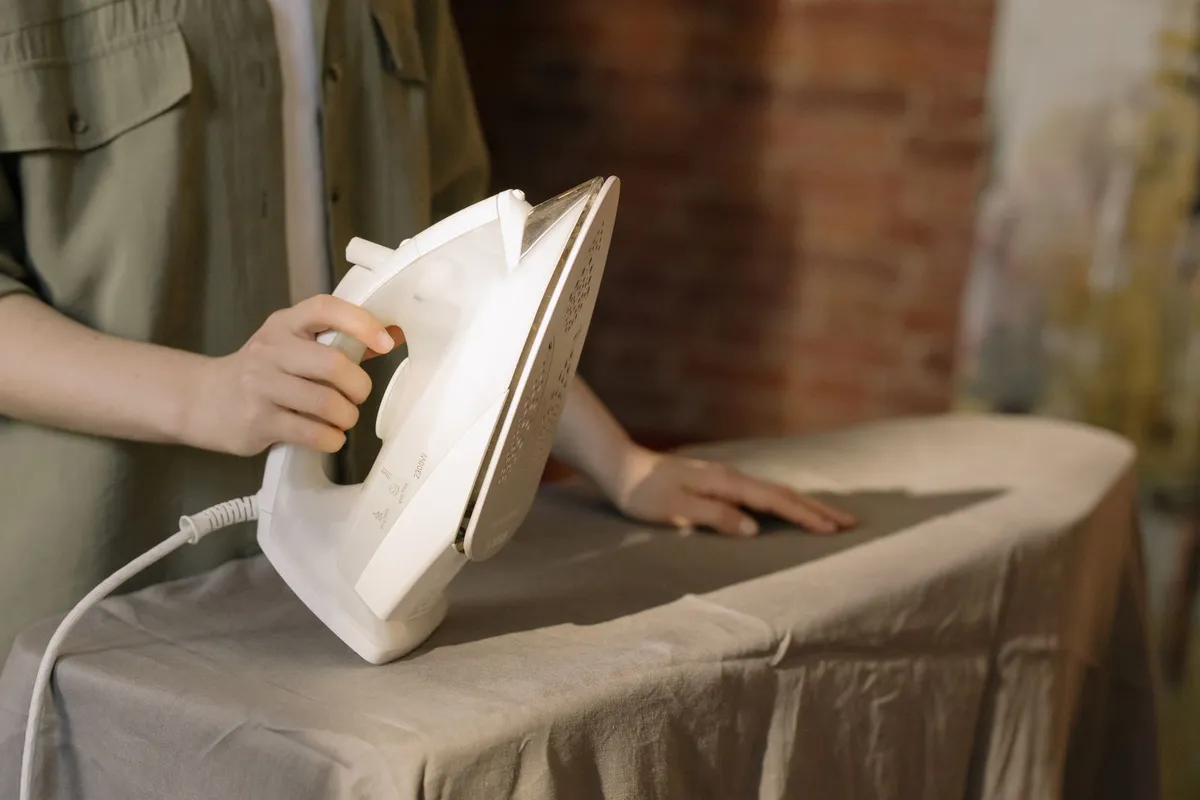
A piece ironed on one side curls as it cools, and a curled bauble turns sideways on the tree. Iron the first side, let it cool under a book, flip it and iron the back the same way. Perler's guides do this for every ornament. Step by step, with temperatures, in how to iron fuse beads.
Bauble
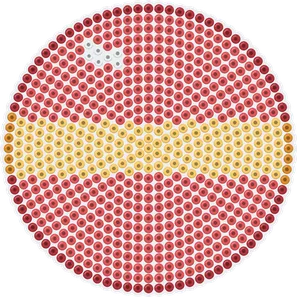
A circle filling most of a 29 × 29 board, with a small rectangle on top as the cap. Three colours is plenty: the ball, a stripe or a zigzag across the middle, and the cap in gold or silver. The hole goes through the cap.
Star
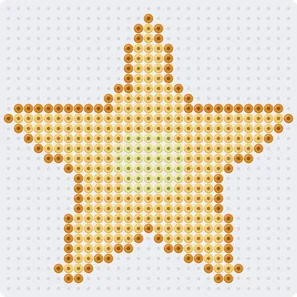
A five-point star on the square board, or a filled star on Hama's star-shaped board, which gives you the outline for free. A single colour reads best from across the room. Add a lighter centre if you like. The hole goes in the top point, two beads down.
Snowflake
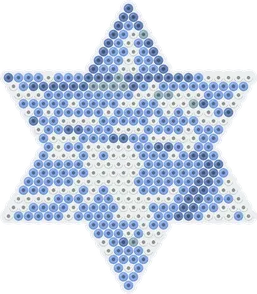
Snowflakes are the one shape that is easier on the star board than on a square one, because the six arms follow the points. White with a few light blue beads, or the other way round. Arms should be at least two beads wide, or they snap in the box.
Candy cane
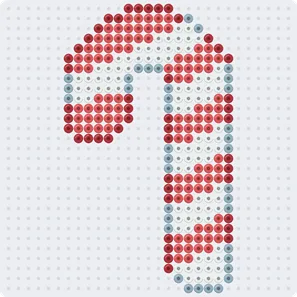
A hook shape, four or five beads thick, in red and white stripes that run diagonally. The curve of the hook is the hole: tie the ribbon around it rather than through it, so nothing has to stay open.
Stocking
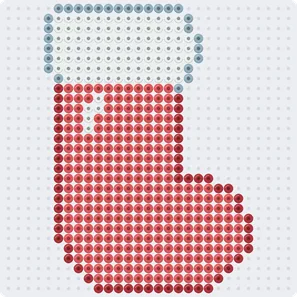
A boot shape in red with a white cuff at the top and a white toe and heel. Write a name on the cuff in beads if it is short, otherwise with a permanent marker on the back after ironing. The holes go through the cuff.
Tree
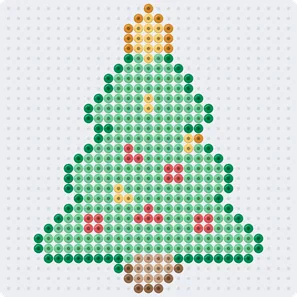
A triangle in green with a brown trunk and a yellow star on top, then scattered single beads in red, blue and gold as baubles. A tree is the best first ornament for a young child: the outline is a triangle and the baubles can go anywhere.
Gingerbread figure
A rounded figure in brown with white beads for the icing along the arms and legs, two eyes and three buttons. Keep arms and legs three beads thick. The hole goes through the head.
Bell
A dome in gold with a flat base and one dark bead as the clapper. Add a red bow at the top with two triangles of red. The hole goes through the bow.
An advent calendar of patterns
A fuse bead advent calendar gives one small pattern a day instead of chocolate. Advent Sunday in 2026 is 29 November, so 1 December is a Tuesday; make the first piece that day and the twenty-fourth on Christmas Eve. By then the tree is full or the garland runs the length of the mantelpiece. Thread each finished piece onto a cord the same evening, so the growing garland is the calendar.
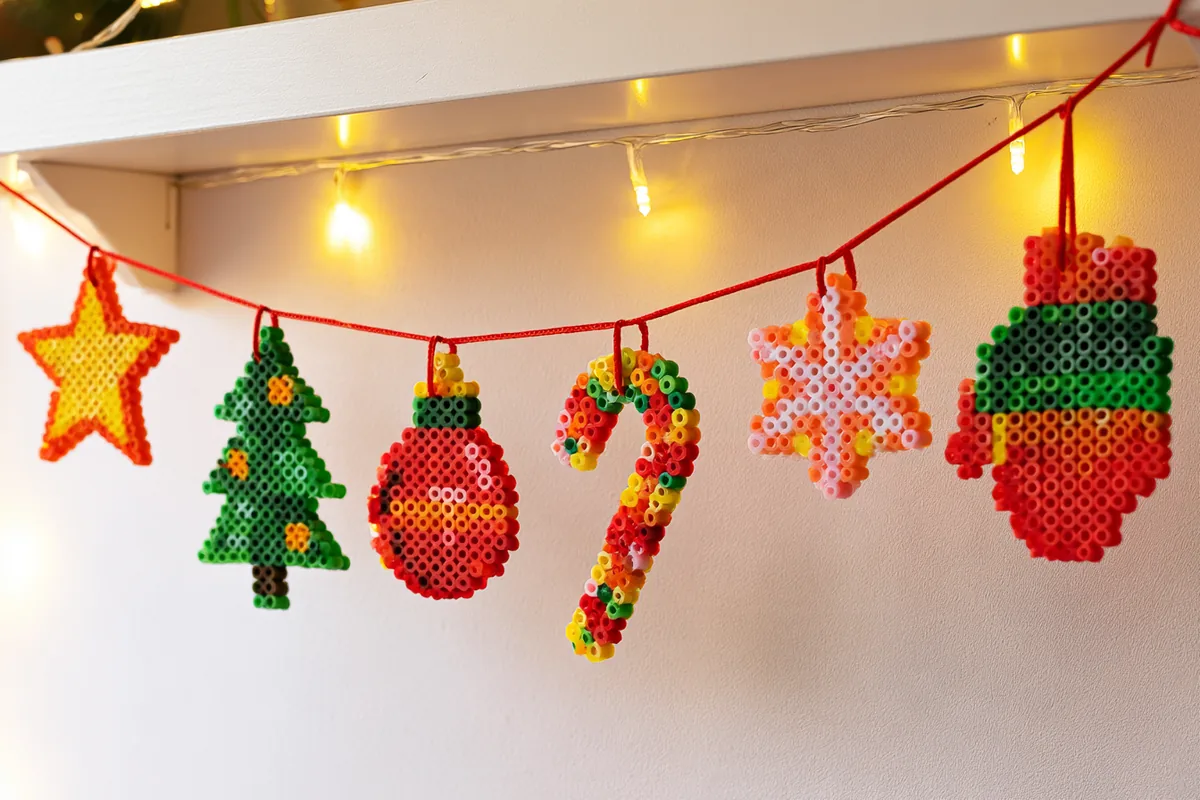
Small, for an advent piece, means a third of a board or less: pieces of 8 to 12 beads across, a few minutes of placing each. In rough order of difficulty, so the easy ones fall on school days and the harder ones on weekends:
- 1A single-colour star
- 2A heart
- 3A bauble in two colours
- 4A candle with a yellow flame
- 5A holly leaf with two red berries
- 6A snowball: a white circle with a grey edge
- 7A present with a ribbon across it
- 8A mitten
- 9A bell
- 10A small tree
- 11A candy cane
- 12A mug of cocoa
- 13A stocking
- 14A snowflake with four arms
- 15A moon and one star
- 16A gingerbread figure
- 17A hat with a pompom
- 18A bird on a branch
- 19A wreath: a green ring with a red bow
- 20A reindeer head with two antlers
- 21A snowman in three circles
- 22A house with a snowy roof
- 23An angel
- 24A big star for the end of the cord
Gifts children can make
- Coasters for grandparents: a full square board in a simple pattern, such as stripes or a snowflake in the middle, ironed hard on both sides so it lies flat under a cup. Make a set of four in the same colours.
- A keyring: a small star or tree with a jump ring through a top bead and a split ring on that. Perler's keychain projects work this way. Iron lightly so the hole stays open.
- A portrait of the family dog or cat: take a close-up on a plain background and turn it into a pattern with the pattern maker. On one board the picture is simplified, so keep to one animal and one board for a first try; the result is a likeness, not a copy. The grandparent who gets it will know exactly who it is.
- A name tag for the stocking: the first letter of the name, large, or the whole name in block letters at least two beads thick, with a hole for a ribbon.
- Gift tags: a tiny tree or bauble with the ribbon of the parcel through its hole. The tag is a second present.
Wrap fused pieces in tissue paper rather than in a box with other things; a corner of a hard present can snap a thin arm.
Does a tree-topper star fit on one pegboard?
No: a star big enough for the top of the tree does not fit on one 29 × 29 board. Push two square boards together so the pegs line up, and lay the pattern across the join. Iron the piece on the boards as usual; the seam fuses like any other row. Flip and iron the back as well. Attach it with a loop of wire or a ribbon through two holes at the bottom point, around the top of the tree.
Hama and Perler boards both link on their edges, and the maker in Kippadoo can lay a pattern across 2 × 2 boards (58 beads across) if you want a star with a border or a face in it. Joining and the seam are explained in 3D fuse bead projects, which uses the same trick for walls.
Keeping ornaments for next year
- Cool completely before anything goes in a box. A warm piece bends and stays bent.
- Flat, in one layer, between sheets of baking paper or in a biscuit tin with paper between the layers. A tangle of ribbons in a bag is how arms break.
- Away from heat. A loft in summer gets hot enough to soften beads; a cupboard indoors is better.
- Write the year on the back with a marker. In ten years a box of dated stars from a child's hand is the best thing in the loft.
The Christmas pack
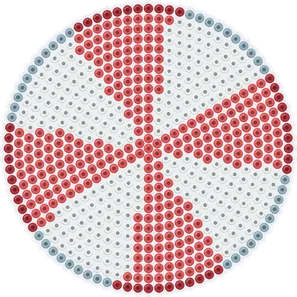
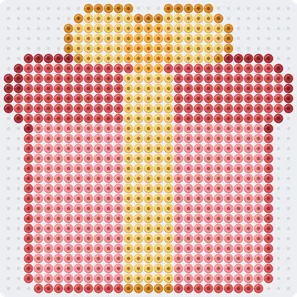
If you would rather have the patterns ready than draw them, the Christmas pack has eight: a Christmas tree, a bauble, a peppermint, a star, a snowflake, a gift, a stocking and a candy cane. Each fits one pegboard; the snowflake is drawn for the star-shaped board. One of the eight is free to try. Every pattern prints at actual size, so a transparent board can lie on top of it, with the colour codes and the number of beads of each colour you need. Open any of them in the maker to change colours or add a name.
The eight patterns, one pegboard each:
Where to buy
The links below go to a search on Amazon. They are paid links: Kippadoo earns from qualifying purchases, and the price stays the same for you.
- Red, green and white Hama beads, 1,000 a bag (paid link)
- Gold and silver beads for caps and bells (paid link)
- A star-shaped pegboard (paid link)
- Thin ribbon or cord for hanging (paid link)
- Ironing paper (paid link)
Sources
- Perler, Heart Ornaments: ribbon and cord for hangers; iron one side, let it cool, flip and iron the other.
- Perler, Glittered Ornaments: jump rings and cord as hangers; over-ironing closes the bead holes.
- Hama, Midi pegboard small star: a star-shaped midi board with 181 pegs, from 5 years.
- Hama, Instructions: ironing paper, small circles, cool under a book, ironing by an adult.
As an Amazon Associate, Kippadoo earns from qualifying purchases.
Questions
Leave one or two beads open at the top edge, iron lightly there so the holes stay open, and run a thin ribbon through from back to front. Two holes hang more level than one.
A curling ornament was ironed on one side only. Iron the first side, let it cool under a book, then flip the piece and iron the back as well.
Advent Sunday is 29 November 2026. A pattern-a-day calendar runs from Tuesday 1 December to Christmas Eve, 24 small pieces.
A full 29 × 29 board is 841 beads, but most ornaments use half the board or less. A bag of 1,000 beads of one colour is enough for several ornaments.
Yes. Push two or four square boards together so the pegs line up and lay the pattern across the join. The seam fuses like any other row when you iron.